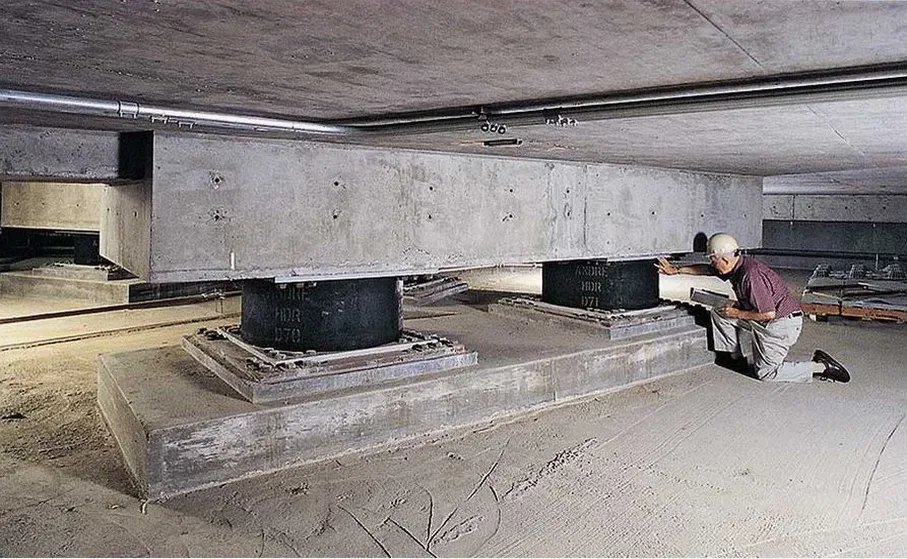
We recently worked on a six-story residential complex near the Coffs Harbour jetty, where the client wanted to reduce seismic risk without over-engineering the foundation. The challenge was the variable alluvial sands and stiff clays that sit beneath the coastal strip. For that project we paired a site-specific ground response analysis with a thorough MASW survey to map shear-wave velocities down to 30 meters, and then used that data to design the base isolation layer. The isolators had to accommodate both the expected lateral displacements and the vertical loads from the structure, all while meeting the deformation limits set by AS/NZS 1170. Getting the soil profile right was the key, and that meant running a full set of laboratory tests on undisturbed samples we recovered from depth.
Base isolation shifts the building's natural period away from the site's dominant frequency, reducing seismic demand by up to 60 percent on soft soils.
Method and coverage
Coffs Harbour sits in a zone of moderate seismicity, but the local geology makes base isolation particularly relevant. The city lies on a mix of Quaternary alluvium and weathered meta-sediments, with the water table often sitting just a few meters below ground. That combination can amplify ground motion at certain frequencies, so a standard fixed-base design would need much larger columns and footings. Instead, we install lead-rubber or high-damping rubber bearings that shift the building's fundamental period away from the dominant site frequency. To get the bearing stiffness right, we first run a plate load test on the founding stratum to measure its modulus of reaction, then calibrate the isolator properties accordingly. The isolators themselves are designed for a service life of 50 years, with replaceable components that let the building owner inspect them after a major event.
Technical reference image — Coffs Harbour
Regional considerations
The most common mistake we see in Coffs Harbour is assuming a one-size-fits-all isolator works everywhere. Builders sometimes order bearings based on generic seismic maps without accounting for the soft estuarine clays near the harbour or the stiff colluvium on the hillsides. That mismatch can cause the isolator to either exceed its displacement capacity or, conversely, to remain rigid and transfer all the seismic shear into the superstructure. Another frequent error is neglecting the vertical component of ground motion: in near-field earthquakes the vertical acceleration can be as high as two-thirds of the horizontal, and if the isolator isn't designed for that uplift, the bearing can separate from its seat. A site-specific seismic hazard analysis, including site-response modeling, eliminates those risks.
We run 1D and 2D equivalent-linear site response models using the shear-wave velocity profile from MASW or borehole data. The output gives the acceleration response spectrum at the base of the isolator, which we then compare to the code spectrum from AS/NZS 1170.4.
02
Isolator Selection & Sizing
Using the site-specific spectrum and the building's mass and stiffness, we select the bearing type (LRB, HDRB, or friction pendulum) and size its diameter, rubber thickness, and lead core diameter. We verify the design against manufacturer test data for prototype bearings.
03
Peer Review & Certification
For projects requiring third-party verification, we review the complete isolation design, including the nonlinear time-history analysis, the isolator-to-structure connection details, and the quality control plan for bearing installation. We issue a certification letter for the certifying engineer.
Standards that apply
AS/NZS 1170.4:2007 (Structural Design Actions – Earthquake Actions), AS 1726:2017 (Geotechnical Site Investigations), AS 4678:2002 (Earth Retaining Structures – relevant for basement walls adjacent to isolators), Eurocode 8 – Part 1 (EN 1998-1:2004)
Top questions
How much does a base isolation seismic design cost for a typical Coffs Harbour building?
For a mid-rise building (4–8 stories) on Class C or D soil, the full design package including site response analysis and isolator specification typically ranges between AU$6.950 and AU$12.020. The final price depends on the number of isolators, the complexity of the site geology, and whether peer review is required.
What soil conditions in Coffs Harbour make base isolation necessary?
Sites with soft alluvial clays or loose sands that amplify long-period ground motion are prime candidates. In Coffs Harbour, the estuarine deposits near the jetty and the colluvial slopes on the hillsides can produce site periods between 0.6 and 1.2 seconds. If the building's fixed-base period falls in that range, base isolation becomes a cost-effective way to avoid resonance.
How long does the design process take from investigation to final specification?
The full process takes 8 to 14 weeks. The first 2–3 weeks are for the field investigation and laboratory testing, then 3–4 weeks for the site response analysis and isolator sizing, and finally 2–3 weeks for the detailed design drawings and the peer review documentation, if required.
Do I need a separate geotechnical investigation before the isolation design?
The reference range for this service in Coffs Harbour is AU$6.950 - AU$12.020. The final price depends on the project scope and volume.