Under AS 1726 (Geotechnical Site Investigations), a soil mechanics study is the baseline for any structural design in Coffs Harbour. The region’s complex geology—ranging from coastal sands to residual soils overlying the Coffs Harbour Block—demands site-specific data rather than blanket assumptions. We apply standard penetration testing, Atterberg limits and triaxial shear to classify subsurface conditions, often combining this with a losa de cimentacionanalysis when slab-on-ground designs are considered. Without this foundation, even modest retaining walls or single-storey dwellings risk differential settlement or bearing failure.
In Coffs Harbour, colluvium and fill layers beneath topsoil demand site-specific data rather than blanket assumptions for safe foundation design.
Method and coverage
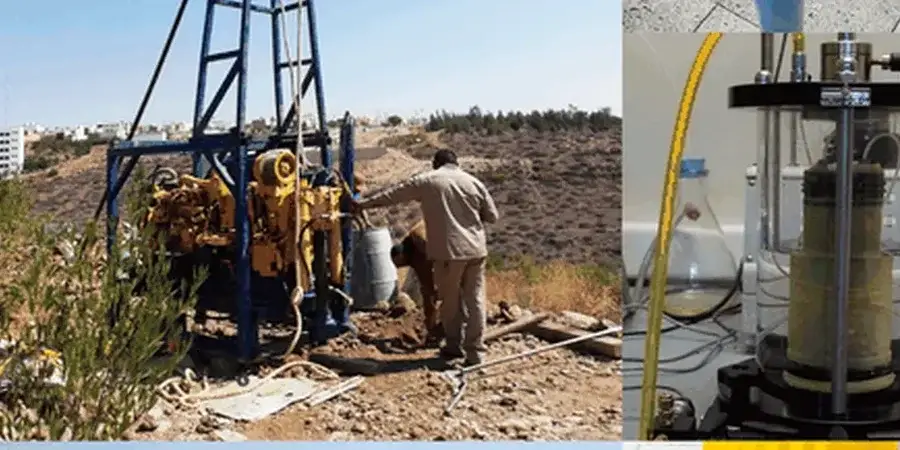
In Coffs Harbour, many projects sit on steep allotments bordering the Great Dividing Range, where colluvium and fill layers hide beneath topsoil. Our soil mechanics study addresses this variability through phased fieldwork. First, we drill boreholes or excavate test pits to log soil profiles. Then we extract undisturbed samples for laboratory testing: moisture content, particle size distribution (AS 1289.3.6.1), and direct shear strength. For sites near the coast, we also check for aggressive soil conditions affecting concrete durability. The result is a clear set of design parameters—cohesion, friction angle, allowable bearing capacity—that engineers can trust. Where slopes are involved, we integrate findings with a estabilidad taludes assessment to confirm long-term stability under both static and seismic loads.
Technical reference image — Coffs Harbour
Regional considerations
Coffs Harbour’s urban expansion over the past 30 years pushed development into former floodplains and hillsides originally considered unbuildable. The 1999 landslip on Bruxner Park Road exposed how shallow colluvium over weathered phyllite can fail after prolonged rainfall. A soil mechanics study identifies these hazard zones early, quantifying slip surface depth and groundwater conditions. Skipping this step means accepting the risk of structural damage, insurance disputes, or even evacuation orders during La Niña events. Our testing program is designed to flag such issues before foundation work begins.
Borehole drilling, test pit excavation and continuous sampling to AS 1726. We record lithology, groundwater strikes and recovery percentages, producing a borehole log that becomes the core of your soil mechanics report.
02
Laboratory Classification & Strength Testing
Atterberg limits, particle size distribution, triaxial compression and Proctor compaction. All tests follow AS 1289 methods and NATA endorsement, ensuring results are accepted by council and certifiers without dispute.
This service complements our laboratory testing work for a complete project analysis.
Standards that apply
AS 1726 – Geotechnical Site Investigations, AS 4678 – Earth Retaining Structures, AS/NZS 1170.0 – Structural Design Actions (general principles), AS 1289.6.3.1 – Standard Test Method for SPT
Top questions
How long does a soil mechanics study take in Coffs Harbour?
A standard residential study—two boreholes to 5–6 m depth plus lab work—takes 7–10 working days from site access to report delivery. Larger commercial projects with multiple test locations may require 3–4 weeks. Weather delays are common during the wet season (December–March), so we recommend planning ahead.
What is the typical cost range for a soil mechanics study in Coffs Harbour?
The cost ranges between AU$4,270 and AU$9,200 depending on the number of boreholes, depth of investigation and laboratory tests required. A basic single-house lot with two boreholes and standard classification tests sits at the lower end; multi-level developments with slope stability analysis fall at the upper end.
Do I still need a soil mechanics study if the site has been filled?
Absolutely. Filled ground is often the riskiest scenario—heterogeneous compaction, organic content and hidden voids can cause differential settlement years later. A soil mechanics study identifies fill depth, compaction level and bearing capacity, guiding whether removal or Improvement (e.g., dynamic compaction) is needed before construction.