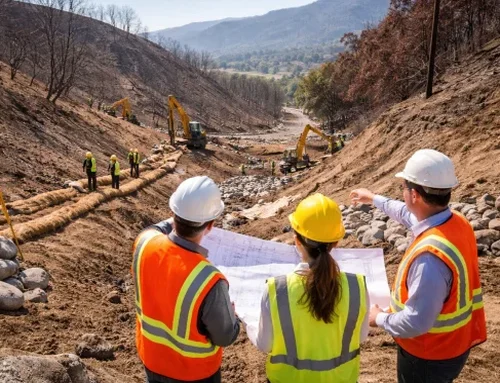
A recent road embankment project near the Coffs Harbour bypass required preloading with surcharge to manage deep soft clays up to 8 metres thick. Coastal floodplain deposits in Coffs Harbour often exhibit low undrained shear strength and high compressibility, making staged surcharge fills the preferred Improvement method. We design surcharge heights and consolidation periods using oedometer test results from undisturbed samples, combined with piezometer data to track pore pressure dissipation. This approach avoids bearing capacity failures and accelerates primary consolidation before final construction, ensuring long-term pavement performance. Before specifying surcharge loads we typically run a dilatometer test to evaluate in-situ lateral stress and modulus, which refines the settlement prediction.
Preloading with surcharge in Coffs Harbour typically achieves 80-90% primary consolidation within 3-6 months, using wick drains in 70% of cases.
Method and coverage
Soils in the Coffs Harbour show distinct behaviour: the eastern coastal strip contains soft estuarine clays with natural moisture content above 70%, while the western hillside areas have residual clayey sands from Meta-Argillite weathering. For preloading design we compare these two zones because consolidation coefficients differ by an order of magnitude. In the coastal clays we use vertical wick drains to shorten drainage paths and accelerate consolidation under surcharge; in the residual soils the lower compressibility often allows simple surcharge fills without drains. All designs incorporate AS 1726-2017 for site investigation and AS 4678-2002 for earth retaining structures where surcharge edges require stability checks. We also cross-check slope stability during filling with a stability analysis of slopes to prevent rotational failures in the soft foundation layer.
Technical reference image — Coffs Harbour
Regional considerations
A common risk in Coffs Harbour preloading projects is undrained failure of the foundation during rapid fill placement. We monitor pore pressure with VW piezometers installed at 2 m intervals below the fill footprint; if excess pore pressure ratio (ru) exceeds 0.5 we pause loading. Another risk is differential settlement between the surcharge area and adjacent untreated ground, especially near transition zones to bridge abutments. We model this using 2D finite element consolidation analysis and specify a staged removal sequence. Preloading with surcharge design in Coffs Harbour must account for seasonal rainfall infiltration that can soften the working platform, so we maintain a minimum 0.5 m drainage blanket beneath the fill.
We design the surcharge height, staging plan, and monitoring array including settlement plates, piezometers, and inclinometers. Our team calculates the required fill duration from oedometer data and specifies surcharge removal criteria based on pore pressure and settlement rate targets.
02
Wick Drain & Consolidation Analysis
For low-permeability clays we design vertical wick drain layouts (band drains) to reduce consolidation time. We determine drain spacing, length, and orientation using radial consolidation theory and verify performance through field settlement monitoring and post-construction cone penetration tests.
This service complements our laboratory testing work for a complete project analysis.
Standards that apply
AS 1726-2017 Geotechnical Site Investigations, AS 4678-2002 Earth Retaining Structures, AS/NZS 1170.0-2002 Structural Design Actions – General Principles, AS 1289.6.6.1-1998 Methods of Testing Soils – Determination of Compressibility (Oedometer)
Top questions
How long does preloading with surcharge typically take in Coffs Harbour?
For soft estuarine clays with wick drains, primary consolidation to 90% U usually takes 3-6 months. Without drains, the same soil could require 12-18 months. The exact duration depends on clay layer thickness and the coefficient of consolidation (cv) measured in oedometer tests.
What is the typical surcharge height used for road embankments in Coffs Harbour?
Surcharge heights range from 2.5 m to 6.0 m above the final grade, depending on the design embankment load and the compressibility of the foundation. We calculate the additional height required to compensate for settlement during the consolidation period, usually 30-50% above the final service load.
How much does preloading with surcharge design cost in Coffs Harbour?
The cost for a full preloading design including instrumentation plan and monitoring typically falls between AU$1,370 and AU$3,340, varying with site complexity and number of monitoring points. This excludes installation of wick drains or supply of fill material.
What site investigation is needed before designing a surcharge fill?
We require at least two boreholes to 1.5 times the clay thickness for undisturbed sampling, plus oedometer and triaxial tests. Piezometers installed before filling provide baseline pore pressure data. A cone penetration test with pore pressure measurement (CPTu) helps stratify the clay profile and identify sand lenses that affect drainage.