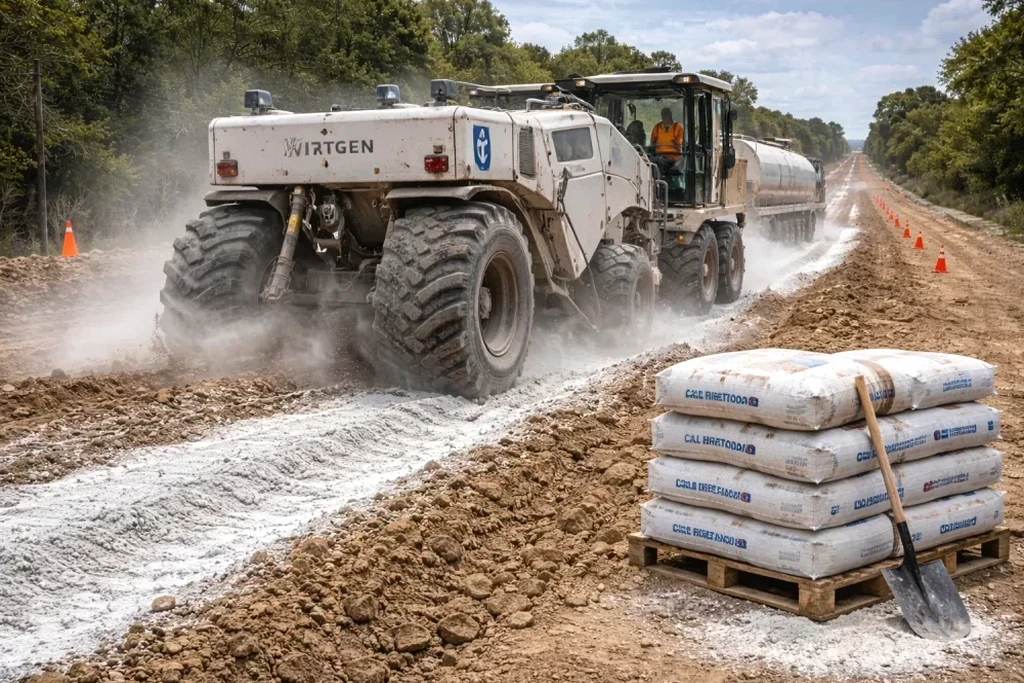
The subgrade soils across Coffs Harbour are dominated by heavy clay from the Orara Valley alluvium, which swells considerably when wet and shrinks during dry spells. This reactivity causes road pavements to crack and deform if untreated. For any road project here, proper soil stabilization for roads is not optional — it is the foundation of long-term pavement performance. We typically test the plasticity index first with Atterberg limits, then select the stabilizer type. Lime works best for high-plasticity clays, while cement suits sandy loams found near the coast. Before specifying the mix, we also run a densidad cono arena to verify in-situ compaction against the target Proctor density. This data drives the dosage design.
Untreated clay in Coffs Harbour can swell up to 70 mm per metre depth — stabilization locks that movement down.
Method and coverage
Soils in the Coffs Harbour CBD differ sharply from those in the Sapphire Beach area. The CBD sits on firm sandy clay with moderate swell potential, while Sapphire Beach has loose silty sands near the water table. This variation means the stabilization approach must be tailored block by block. For example, in the CBD we can often use quicklime at 3–5% by dry weight, whereas near the coast cement treatment at 4–6% is more effective. We always verify the design with unconfined compressive strength tests on cured specimens. If the project involves steep cuts, we combine the stabilization with an estabilidad taludes analysis to ensure the treated layer doesn't slide. The same stabilization principles apply whether you are building a minor access road or a major arterial — the dosage and curing time adjust accordingly. We follow AS 1726 for site investigation and AS 4678 for earth retaining structures when stabilization supports a wall.
Technical reference image — Coffs Harbour
Regional considerations
Coffs Harbour averages over 1,600 mm of rain per year, with intense summer storms that can saturate subgrades within hours. If stabilization is done too late in the wet season, the treated layer may not cure properly before the next downpour. The risk is a soft, under-strength base that fails under traffic loads. We schedule stabilization during the drier winter months or use fast-setting polymer binders when the window is tight. A proper drainage plan — including subsoil drains — is essential to keep the stabilized layer from re-wetting after compaction. We also check sulfate content in the soil; if sulfates exceed 0.5%, lime can cause expansive ettringite, so we switch to cement or fly ash.
Treatment of high-plasticity clays (PI > 30) with quicklime or hydrated lime. Reduces plasticity, improves workability, and increases CBR. Typical depths: 200–400 mm. Includes mix design, field trials, and compaction testing.
02
Cement Stabilisation for Granular Soils
General purpose Portland cement or blended cement for sandy and silty subgrades. Achieves rapid strength gain, suitable for traffic opening within 48 hours. Depth range 150–350 mm. We calibrate cement content via unconfined compression tests.
This service complements our laboratory testing work for a complete project analysis.
Standards that apply
AS 1726:2017 Geotechnical site investigations, AS 4678:2002 Earth retaining structures, Austroads Guide to Pavement Technology Part 4C: Stabilisation, AS 1289.3.1.1 Atterberg limits, AS 1289.5.1.1 Standard Proctor compaction
Top questions
How much does soil stabilization for roads cost in Coffs Harbour?
For a typical road project in Coffs Harbour, the cost ranges between AU$1,210 and AU$5,090 depending on treatment depth, stabilizer type, and total volume. This includes mix design, field application, and compaction testing. Larger volumes reduce the unit rate.
How long does stabilized soil take to cure before traffic can use the road?
Cement-stabilized layers can carry light traffic within 48 hours, while lime-stabilized clay usually needs 7 to 14 days of curing. We apply a moisture seal (curing compound or wet hessian) to prevent rapid drying, especially during Coffs Harbour's windy spring afternoons.
Can stabilization be done on a road that already has pavement failures?
Yes, but we first need to identify the failure cause. If the subgrade is the problem, we scarify the existing pavement, remove any organic material, mix in the stabilizer, and re-compact. A grouting program may also be needed if there are voids underneath. The new stabilized layer becomes the pavement base.